
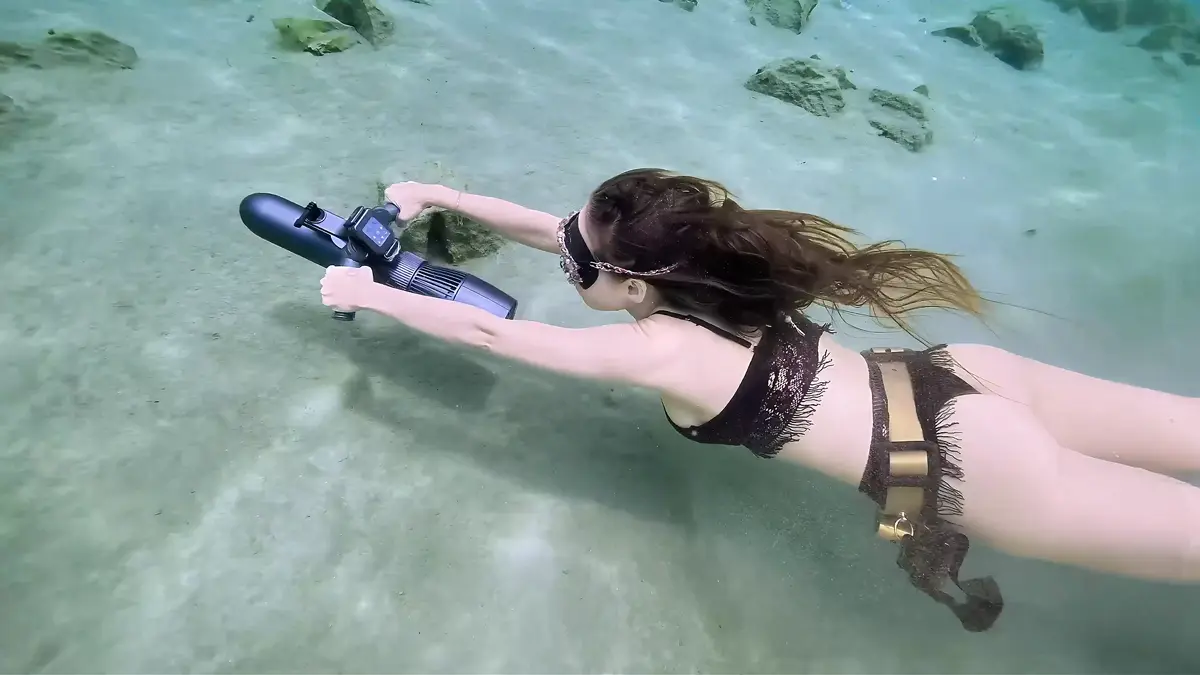
How to Choose an Underwater Scooter for Scuba Diving: 7 Specs That Matter
Choosing an underwater scooter for scuba diving involves more than comparing top speed or motor wattage. Battery capacity, realistic runtime, operating depth, handling, and service support all affect how well a model fits its intended use.
For divers, the goal is to match the scooter to the type of diving you actually do. For dive shops and distributors, the same decision also affects customer fit, product positioning, documentation, and after-sales support.
KESZING currently offers several electric underwater scooter platforms, from the compact LXHD 6-1 to the higher-output LXHD 7-1. The LXHD 7-1 is the main model to evaluate when the priority is a 700W propulsion platform, 355.2Wh battery, and 3–9 km/h speed range.
Before choosing a dive scooter, DPV, or diver propulsion vehicle, compare these seven specifications.
Motor Power: What Matters in an Underwater Scooter for Scuba Diving
Motor wattage is useful, but it is not a complete measure of underwater performance.
The LXHD 5-2 and LXHD 5-3 use 500W brushless motors. The compact LXHD 6-1 uses a 650W motor, while the flagship LXHD 7-1 and LXHD 7-1 PLUS use 700W brushless motors.
A higher-power platform can provide more propulsion headroom, but the real experience also depends on the propeller, controller, battery, drag, load, and speed setting. That is why the best underwater scooter for one diver may not be the most powerful model.
Speed Range: Control Matters More Than Maximum Speed
Maximum speed is easy to compare, but scuba diving rarely requires full-speed operation for an entire dive.
KESZING currently lists 3–7 km/h for the LXHD 5-2, LXHD 5-3, and LXHD 6-1, and 3–9 km/h for the LXHD 7-1 and LXHD 7-1 PLUS.
When comparing a dive scooter, ask what the usable speed range is and how easily the diver can control it underwater. A lower maximum speed may still be a better fit if portability or endurance matters more.
Battery Capacity: Use Watt-Hours for a Better Comparison
Battery capacity is often shown in mAh, but watt-hours are especially useful for comparing how much energy different battery systems store.
The LXHD 5-2 uses a 222Wh built-in battery. The LXHD 5-3, LXHD 7-1, and LXHD 7-1 PLUS each use 355.2Wh built-in batteries. The LXHD 6-1 uses a replaceable 99.9Wh battery, with two batteries included in the current package.
This creates different product strategies: the LXHD 5-3 emphasizes endurance within the 500W class; the LXHD 7-1 pairs 355.2Wh with a 700W platform; and the LXHD 6-1 prioritizes compact size and a replaceable-battery format.
For an underwater scooter for scuba diving, battery energy should be considered together with motor power, runtime, weight, and intended use.
Runtime: Read the Range, Not Just the Highest Number
KESZING currently lists 40–160 minutes for the LXHD 5-2, 60–200 minutes for the LXHD 5-3, 15–85 minutes for the LXHD 6-1, and 35–160 minutes for both the LXHD 7-1 and LXHD 7-1 PLUS.
The LXHD 5-3 and LXHD 7-1 both use 355.2Wh batteries, but their motor platforms and listed runtime ranges differ. This is why battery size and motor wattage should not be judged separately.
Published runtime should be treated as an operating range rather than a guaranteed duration for every dive. Speed, load, drag, water conditions, and use pattern can change actual operating time.
Operating Depth and Waterproof Design: Check Both
The five KESZING models compared here currently list a maximum diving depth of 30 m / 98.43 ft and an IPX8 waterproof rating.
Those are separate specifications. A waterproof rating should not be interpreted as permission to operate beyond the product’s stated maximum depth. Divers should follow the current manual and operating limits for the exact model.
For dive shops and distributors, make sure product pages, manuals, specifications, and sales materials all refer to the same model and operating limits.
Weight, Buoyancy, and Handling: Think Beyond the Spec Sheet
Current listed net weights are 3.1 kg for the LXHD 5-2, 3.65 kg for the LXHD 5-3, 2.59 kg for the LXHD 6-1 main unit, 4.05 kg for the LXHD 7-1, and 4.31 kg for the LXHD 7-1 PLUS.
The LXHD 6-1 is the lightest and most compact option in this group. The LXHD 7-1 PLUS adds a buoyancy chamber to the 700W platform.
Handling questions include grip position, turning, balance, behavior when propulsion stops, and comfort during longer sessions. Real underwater video is especially useful because these qualities are difficult to judge from a specification table.
Divers should also understand proper scooter handling and dive planning before using a DPV. For additional training information, see the PADI Diver Propulsion Vehicle (DPV) course.
Serviceability and Documentation: Essential for B2B Buyers
Consumer comparisons often stop at speed and runtime. Dive shops and distributors should also verify the current user manual, charger specification, battery information, model-specific technical documents, available product media, and support channels.
KESZING maintains a Partner Support area with manuals, technical documents, images, videos, and guide materials for supported products. For B2B buyers, support resources should be part of the purchasing decision rather than an afterthought.

LXHD 5-2

LXHD 5-3

LXHD 6-1

LXHD 7-1

LXHD 7-1 PLUS
KESZING Underwater Scooter Comparison
On mobile, swipe left or right to view all specifications.
| Model | Motor | Battery | Speed Range | Listed Runtime | Net Weight | Positioning |
|---|---|---|---|---|---|---|
| LXHD 5-2 | 500W | 222Wh | 3–7 km/h | 40–160 min | 3.1 kg | Entry 500W platform |
| LXHD 5-3 | 500W | 355.2Wh | 3–7 km/h | 60–200 min | 3.65 kg | Endurance-focused 500W model |
| LXHD 6-1 | 650W | 99.9Wh each; 2 included | 3–7 km/h | 15–85 min | 2.59 kg main unit | Compact replaceable-battery model |
| LXHD 7-1 | 700W | 355.2Wh | 3–9 km/h | 35–160 min | 4.05 kg | Flagship higher-output scuba-diving platform |
| LXHD 7-1 PLUS | 700W | 355.2Wh | 3–9 km/h | 35–160 min | 4.31 kg | 700W platform with buoyancy chamber |
Which KESZING Model Should You Choose?
The LXHD 5-2 is the straightforward 500W starting point. The LXHD 5-3 is the stronger choice when the priority is longer listed endurance within the 500W class.
The LXHD 6-1 is the portability-oriented option, with a compact body and replaceable 99.9Wh batteries.
For scuba divers and distributors who want KESZING’s higher-output platform, the LXHD 7-1 should be the first model to evaluate. It combines a 700W brushless motor, 355.2Wh battery, 3–9 km/h speed range, 35–160 minute listed runtime, and 30 m maximum diving depth.
The LXHD 7-1 PLUS is the alternative when the same 700W performance class is desired with an added buoyancy chamber.
There is no universal best scuba scooter for every diver. The better choice is the model whose power, speed, battery, runtime, depth, handling, and support fit the intended use.
FAQ
Is a DPV the same as a scuba scooter?
DPV stands for diver propulsion vehicle. In normal product searches, DPV, dive scooter, scuba scooter, and underwater scooter often overlap, although individual products can differ substantially in specifications and intended use.
How much motor power does an underwater scooter for scuba diving need?
There is no single wattage that suits every diver. A 500W platform may fit recreational use, while a 700W platform such as the LXHD 7-1 provides a higher-output option. Compare wattage together with speed, battery, runtime, handling, and depth.
Is the fastest dive scooter always the best underwater scooter?
No. Maximum speed is only one part of the decision. Controllability, runtime, operating depth, weight, and handling can matter just as much.
Which KESZING scuba scooter has the longest listed runtime?
Among the five models compared here, the LXHD 5-3 has the longest current listed runtime range at 60–200 minutes.
Which KESZING model should distributors evaluate first?
For a higher-output diving position, start with the LXHD 7-1, then compare the other models according to price tier, endurance, portability, and buoyancy needs.
Ready to compare KESZING underwater scooters for diving, retail, or distribution? Explore the underwater scooter range or apply to become a KESZING partner.
One Comment