
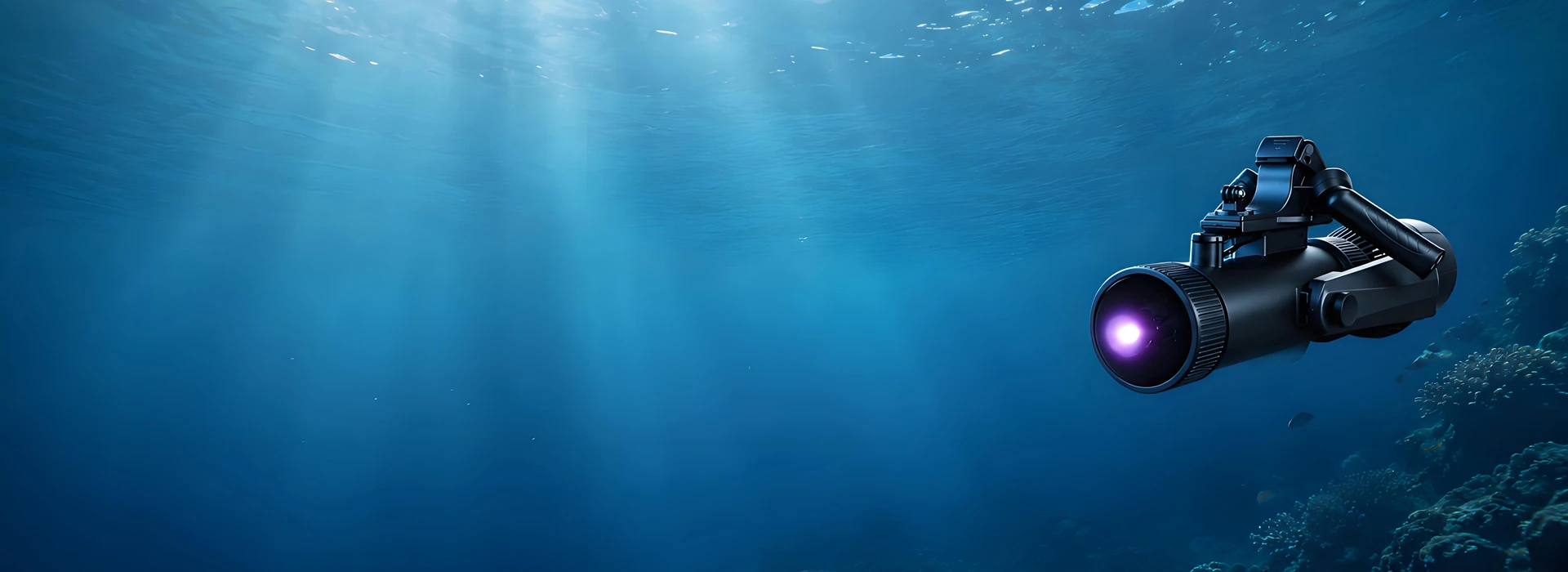
Brushless Motor
Ideal Power Source for Underwater Scooters & Watercraft
OBLM4990 Outer Rotor Submersible Brushless Motor
KESZING develops and manufactures brushless motor solutions for underwater propulsion. The OBLM4990 is a three-phase sensorless outer rotor BLDC motor engineered for underwater scooters, ROVs, diving thrusters, and compact electric watercraft. Its fully sealed construction is designed for reliable operation in fresh and salt water.
Contact Us
Brushless Motor Engineering Advantages
Purpose-built for underwater propulsion applications where compact size, strong torque, sealing reliability, and corrosion resistance are critical.
Outer Rotor BLDC Architecture
The three-phase sensorless outer rotor design delivers strong low-speed torque and high power density in a compact format, making it well suited to space-constrained underwater propulsion systems.
Fully Sealed Waterproof Construction
The motor uses an integrated sealed housing that is assembled and validated at the factory for underwater operation. The structure is intended for use in both fresh water and salt water when installed and operated according to the specified conditions.
Underwater Propulsion Efficiency
A compact metal housing and propulsion-focused design help reduce unnecessary hydrodynamic resistance while supporting stable thrust output in underwater scooter, ROV, and marine thruster applications.
OBLM4990 Brushless Motor Technical Specifications
Key electrical and operating parameters for system integration, ESC matching, and propulsion design.
| Parameter | Technical Data |
|---|---|
| Model | OBLM4990 Series |
| Motor Type | Outer Rotor, 3-Phase Sensorless BLDC Motor |
| Rated Operating Voltage | 27.5 VDC |
| KV Rating | 290 KV |
| No-Load Speed | 7960 ±10% RPM |
| Maximum Load Current | 36 A |
| Peak Output Power | 800 W |
| Typical Applications | Underwater Scooters, ROVs, Diving Thrusters |
Brushless Motor Applications for Underwater Propulsion
The OBLM4990 is designed for compact underwater propulsion platforms that require a sealed BLDC motor, practical ESC integration, and dependable thrust performance.
Underwater Scooters & Electric Watercraft
Suitable as a propulsion motor for underwater scooters, snorkeling propulsion devices, and compact electric watercraft where installation space and power density are important.
ROVs & Underwater Robotics
Can be integrated into compact observation robots, inspection ROVs, and lightweight submersible platforms that require efficient electric propulsion underwater.
Aquaculture & Subsea Equipment
Applicable to underwater circulation equipment, marine inspection systems, and auxiliary thruster assemblies that need a compact sealed brushless motor.
Brushless Motor Integration & Operating Guidelines
Reference information for ESC selection, wiring, battery matching, cooling, and safe underwater operation.
ESC & Wiring Integration
- Sensorless Configuration: The motor uses three phase power wires and does not require Hall sensor signal wiring.
- ESC Requirement: Use a sensorless BLDC controller rated for at least 40 A continuous current with a 24-28 VDC input range.
- Rotation Direction: To reverse motor direction, swap any two of the three phase-wire connections.
- Battery Requirement: A 27.5 V lithium battery pack with at least 40 A continuous discharge capability is recommended to reduce voltage drop under high load.
Critical Operating Safety
- No Dry Running: Do not operate the motor out of water. The motor relies on water for heat dissipation, and dry operation can cause rapid overheating and damage.
- Full-Load Duty Cycle: At peak full-load output, limit continuous operation to 15 minutes and allow at least 5 minutes for cooling.
- Operating Depth: The standard housing is rated for operation at depths up to 50 meters. Contact KESZING for requirements beyond the standard depth range.
- Do Not Disassemble: Opening the sealed housing can compromise watertight integrity and may void the product warranty.
Brushless Motor Troubleshooting
Common diagnostic checks for system integrators and technical teams during installation and field operation.
| Symptom | Possible Causes | Recommended Checks |
|---|---|---|
| Motor does not rotate after power-on | 1. Loose or broken phase-wire connection 2. ESC parameter mismatch 3. Battery undervoltage | Inspect all three phase-wire connections; recalibrate or verify the sensorless ESC settings; test with a fully charged 27.5 V battery pack. |
| Strong vibration or abnormal noise | 1. Sand, seaweed, or debris around the propeller 2. Damaged or deformed propeller blade 3. Loose propeller locking component | Remove foreign material; inspect the propeller for damage; replace damaged blades and secure the locking components before further operation. |
| Reduced thrust or RPM under load | 1. Insufficient battery discharge capability 2. Poor phase-wire or terminal contact 3. Excessive motor temperature after sustained high load | Use a battery with adequate continuous discharge capability; inspect and repair loose electrical connections; stop the system and allow the motor to cool before restarting. |
OEM & ODM Brushless Motor Manufacturer Support
As a brushless motor manufacturer focused on underwater propulsion applications, KESZING supports OEM, ODM, and bulk projects with ESC parameter matching, CAD engineering files, and application-specific technical coordination. Share your voltage, installation space, target operating depth, propulsion requirements, and expected order quantity through the inquiry form below. Our engineering and sales team will review your requirements and respond within 24 hours.